Federal regulators say Broward's train quiet zone could be suspended after finding seven problems. Fort Lauderdale voted 4-0 on Nov. 6 to fight to keep it.
The quiet zone that keeps trains from sounding their horns at crossings across Broward County is under federal review and could be suspended. The Fort Lauderdale City Commission voted 4-0 on Friday, Nov. 6, to fight to keep it.
The commission adopted a walk-on resolution committing the city to the zone. The vote is recorded in the city’s meeting record for Nov. 6. The background comes from the city’s agenda memo 26-1111, written by the Transportation and Mobility Department.
What the federal review found
The Federal Railroad Administration issued an inspection report on the countywide quiet zone on Aug. 20, the memo said. It found seven deficiencies in the zone’s original notice of establishment, and safety measures in the field that did not comply. The memo said the problems include:
- outdated crossing inventory data
- missing certifications from the cities in the zone
- overdue periodic updates to the FRA
- no party named as responsible for compliance
The FRA advised that the quiet zone “is subject to suspension and remains under review for termination,” the memo said. The report was addressed to Hollywood, which led the original application. The FRA has confirmed its findings apply to every city in the zone, including Fort Lauderdale, the memo said.
How the quiet zone works
In a quiet zone, train engineers do not routinely sound the horn as they approach a crossing. That is allowed only where crossings carry enough extra safety measures, such as four-quadrant gates and raised medians. The FRA bases its approval on the average risk score across every crossing in the zone.
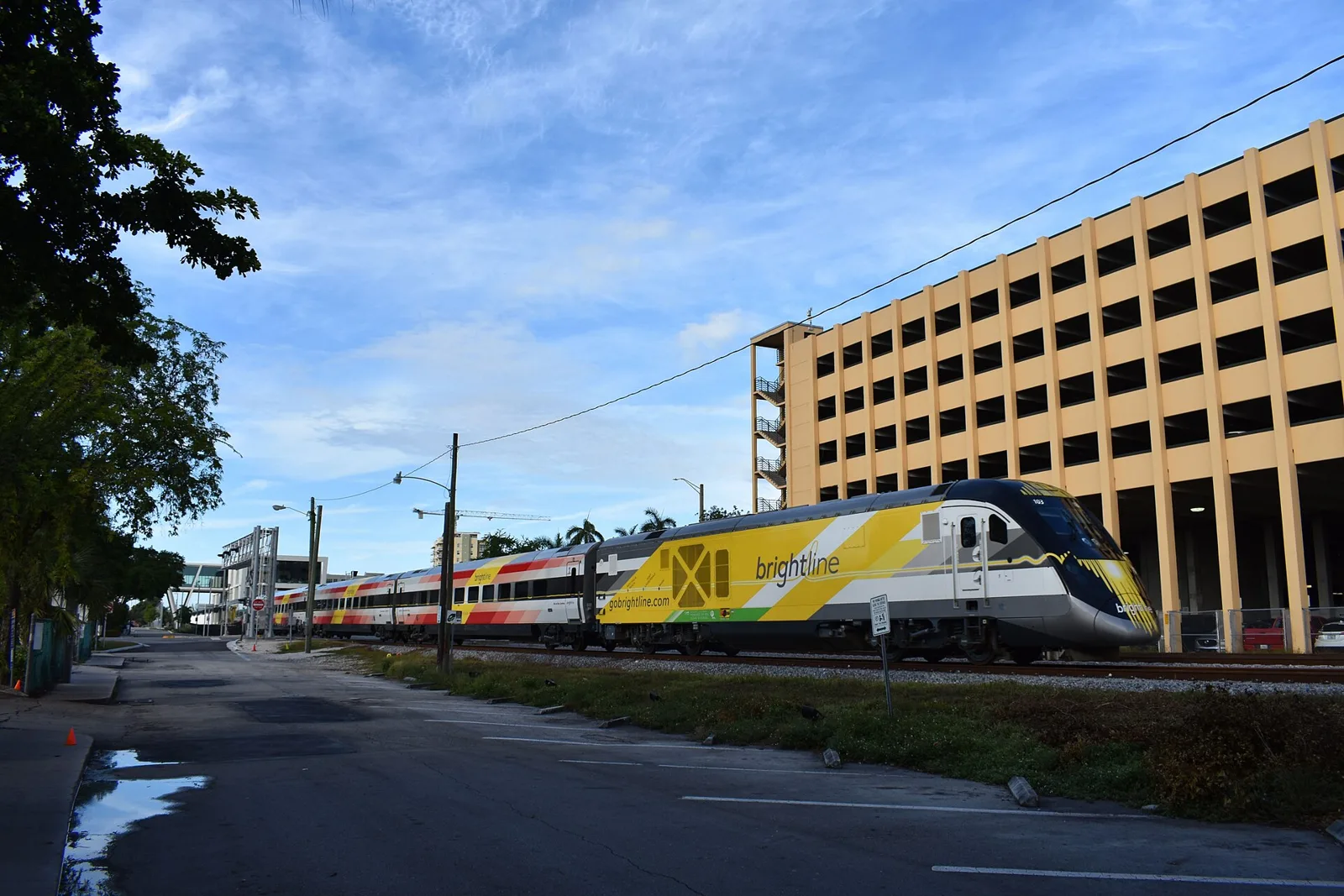
The Broward zone covers the Florida East Coast Railway line through the county’s coastal cities. Brightline passenger trains share the line with freight. The zone took effect on May 18, 2019, the memo said. Fort Lauderdale backed it in December 2015, with Hollywood as lead applicant and Broward County responsible for reports to the FRA, signs and pavement markings.
In June 2022, the FRA raised concerns about the zone at a public meeting hosted by the Broward Metropolitan Planning Organization. It cited several deaths along the corridor, the memo said.
The deadlines
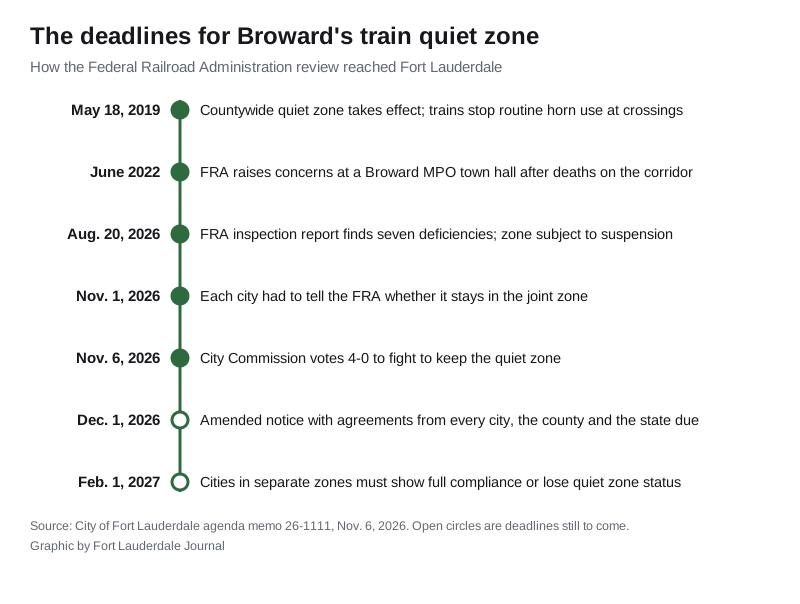
The FRA told each city to say by Nov. 1 whether it would set up its own quiet zone or stay in an amended countywide zone. The amended notice is due 30 days after that. It must include quiet zone agreements from each city, Broward County and the state.
Any city in a separate zone that cannot show full compliance by Feb. 1, 2027, will lose quiet zone status at its crossings, the memo said.
Hollywood’s commission voted on Oct. 21 to keep the joint zone and to stay as lead applicant, according to its Resolution 2026-342, which Fort Lauderdale attached to its agenda.
What Fort Lauderdale agreed to do
The resolution:
- directs the city manager to use staff, money and outside help to keep the existing zone, or to set up a new one in the city or with other cities if needed
- lets the city manager sign the agreements needed with other cities, the MPO, Broward County and the Florida Department of Transportation
- directs the city manager to lobby at the local, state and federal level
- sends the resolution to the other cities on the corridor, the MPO, the county, FDOT and the U.S. Department of Transportation
City staff have also met the FRA’s senior policy advisor and asked for more time, the memo said. Engineering consultants would study the countywide zone for the Dec. 1 deadline, at an estimated cost of up to $150,000.
Staff were plain about the limits. Finishing that work “does not guarantee that the Quiet Zone will remain in place,” the memo said. It would show whether the zone still meets the FRA’s thresholds, and if not, which crossings need work.
The memo listed no cost to the city from the resolution itself but said keeping the zone may carry costs.
The crossing deals passed too
The same night, the commission approved all six crossing agreements with the Florida East Coast Railway, each by 4-0. They let the federally funded Broward County Sealed Corridor Project add exit gates and raised medians in Fort Lauderdale at:
- NE 17th Court (raised medians)
- SW 5th, 6th and 7th streets (exit gates)
- SW 17th Street (exit gates)
- SW 22nd Street (a raised median and exit gates)
The work in the city costs $5,566,127, the memo said. A federal grant pays $4,362,749. The city pays $676,147 and Broward County $527,231. Under the agreements, the city takes on the cost of track and signal upkeep at the six crossings. Our earlier story on the crossing deals has the full costs.
What it means for you
- If you live or work near the tracks, nothing changes yet. Trains are still not sounding horns routinely at crossings. The FRA has said the zone could be suspended, and no date has been set.
- If the zone is lost, train horns would return at the city’s crossings on the Florida East Coast line, including those downtown.
- The next date to watch is Dec. 1, when the amended notice is due to the FRA.
- To tell your commissioner what you think, contact details are on our who to call at City Hall page.
Current road and rail work is on our road construction and closures page, and train options are in our guide to getting around Fort Lauderdale.
Have your say