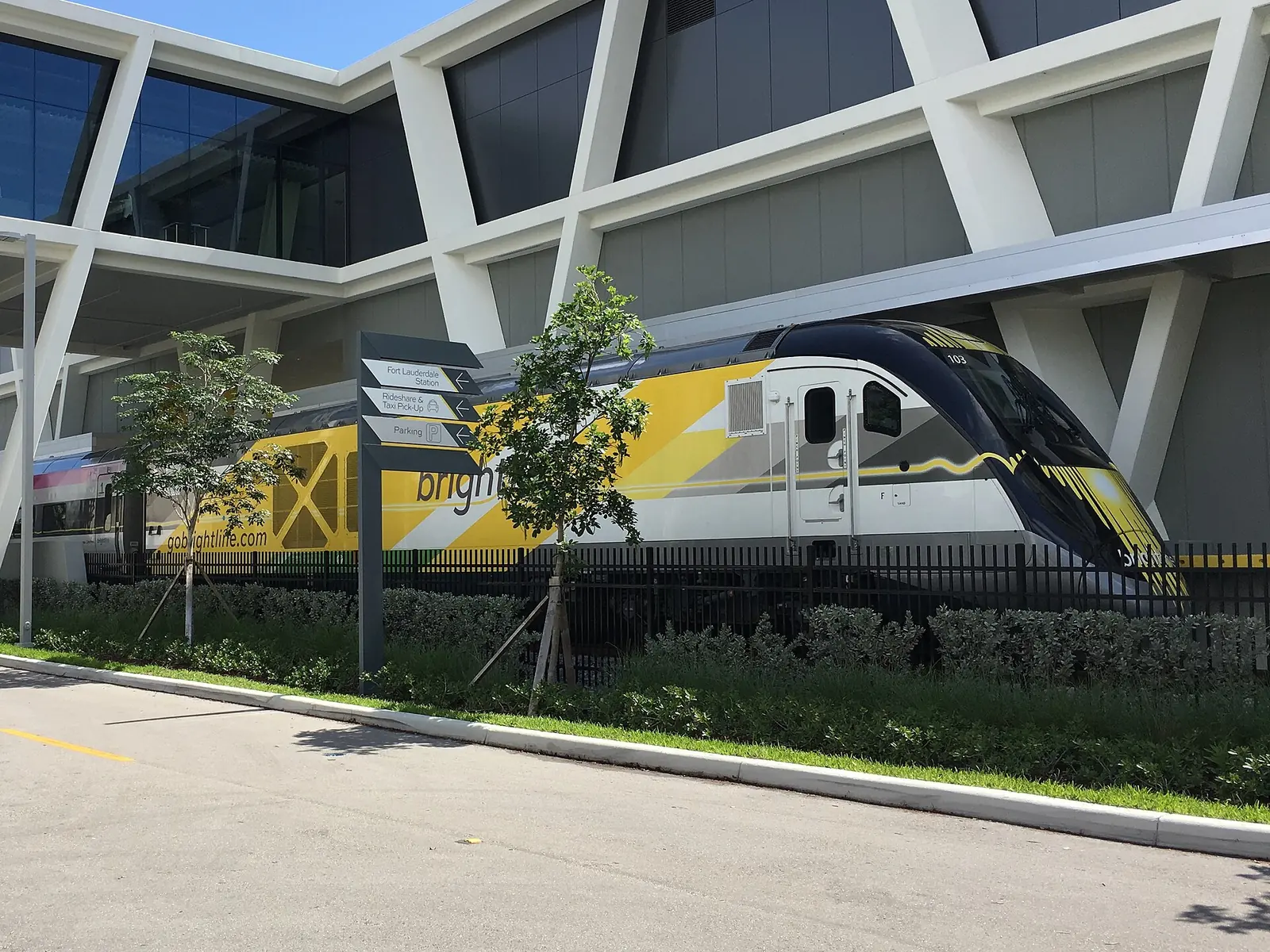
The City Commission votes Friday on six FEC railroad crossing deals tied to new exit gates and medians. The city would pay for track and signal upkeep at all six.
Fort Lauderdale would take on the cost of track and signal maintenance at six railroad crossings under agreements the City Commission votes on Friday. The deals are the price of federally funded safety work on the Florida East Coast Railway line, which Brightline trains share with freight.
The six agreements are on the agenda for the 6 p.m. Friday, Nov. 6, meeting. City staff recommend approval.
The six crossings
All six are in the federally funded Broward County Sealed Corridor Project. Three crossings already have agreements with the railroad, some dating to the 1920s. Those would be amended by letters of agreement among the railroad, the city and Brightline:
- SW 7th Street, under an agreement dated Aug. 18, 1927 (item R-4)
- SW 17th Street, under an agreement dated Dec. 28, 1954 (item R-5)
- SW 22nd Street, under an agreement dated Dec. 28, 1954 (item R-6)
Three crossings have no agreement today and would get new license agreements with the railroad:
- SW 6th Street (item CM-13)
- NE 17th Court (item CM-14)
- SW 5th Street (item CM-15)
The commission will also consider a separate agreement for a railroad crossing used by pedestrians, which is not part of the grant, the city’s agenda memos said.
What the safety work is
The project adds exit gates and raised medians at crossings where drivers have gone around lowered gates. It covers 20 crossings along the 26-mile corridor in Broward County, the Broward Metropolitan Planning Organization said.
The MPO said the countywide plan includes:
- 19 new exit gates, which come down on the far side of the tracks so every lane is blocked
- six raised medians, which stop drivers swinging into oncoming lanes to get around a gate
- work at crossings with at least 27 collisions in the past five years
The MPO said 17% of collisions on the corridor happen when drivers go around entrance gates, and nearly 60% of those are in Broward County. It estimates more than 60 train movements a day on the line. Its project page links draft engineering plans for each crossing, including all six in Fort Lauderdale.
Who pays
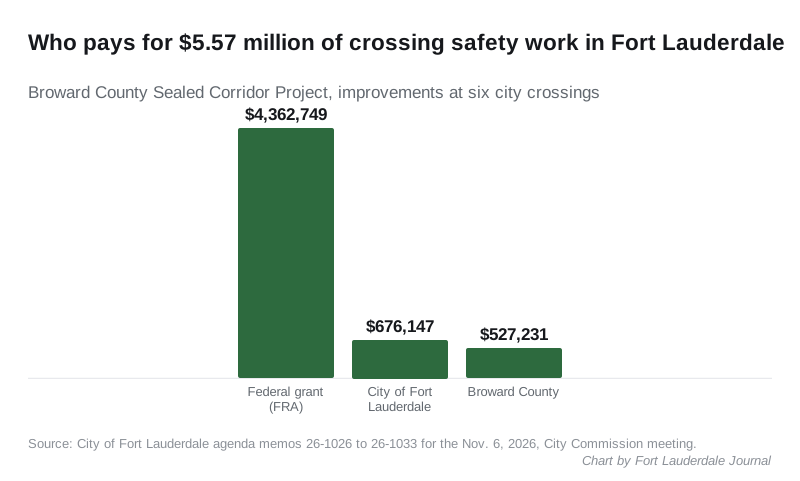
The project costs $19.3 million countywide. Of that, $5,566,127 is for work in Fort Lauderdale, the city’s agenda memo for SW 7th Street said. It breaks down this way:
| Source | Amount |
|---|---|
| Federal Railroad Administration grant | $4,362,749 |
| City of Fort Lauderdale match | $676,147 |
| Broward County match | $527,231 |
The railroad would build the improvements. After that, the cost of keeping them running moves to the city.
Under the current agreements, the railroad maintains the track at the crossing and the city pays part of the signal costs. The letters of agreement shift 100% of future track and signal maintenance done by the railroad to the city, the memo said.
Each of the six agreements carries an estimated first-year cost of $13,309. That is a $3,550 annual license fee plus $9,759 a year to maintain the railroad’s warning devices. The fee rises each year by inflation or 3%, whichever is greater. Across six crossings, the first-year total is $79,854.
City staff were blunter about the three new agreements. Their memo on NE 17th Court said the fixed fees alone for those three crossings come to about $470,000 over 10 years. That does not include unscheduled repairs or work the railroad decides to do.
The same memo said:
- the city would pay all costs of building, maintaining, replacing and removing everything at the crossing, including the track, whether the city or the railroad does the work
- any change the railroad wants at a crossing would be at the city’s full expense
- the city would not control the scope, schedule or pricing of work the railroad chooses to do
- the city would indemnify the railroad, within the limits of state sovereign immunity law
For comparison, the city has spent between about $15,800 (budget year 2021) and $917,100 (budget year 2024) a year on railroad crossing maintenance, an average of about $300,000. Staff said those figures understate what it may pay once it carries the costs in full.
Brightline is not a party to the federal grant and is not responsible for construction or future maintenance costs, the memo said.
Why the deadline matters
The quiet zone along the line is behind the push. In a quiet zone, trains do not routinely sound their horns at crossings. The commission backed the countywide quiet zone in December 2015.
In June 2022, the Federal Railroad Administration told a public meeting hosted by the Broward MPO it was concerned about the county’s quiet zone and would review the corridor, the city’s memos said. The agency stressed that local partners had to work together to prevent deaths if the quiet zone was to stay.
The MPO told the city the signed agreements must reach the FRA by mid-November. Without them, the city’s crossings could be left out of the project or construction could be delayed, staff said.
Staff also said approval does not guarantee the quiet zone stays. The FRA’s concerns are based on the corridor as it is now, not on planned improvements, the memos said.
What it means for you
- If you drive across the FEC tracks at any of these six crossings, expect exit gates or medians once the work is built. No construction dates have been published.
- If you live near the tracks, the quiet zone is the reason trains do not routinely sound their horns at crossings. The city’s own staff say the vote does not guarantee it stays.
- As a taxpayer, the agreements add a new, rising line to the city’s general fund budget. The memos said the first year’s cost depends on approval of the budget amendment on the same agenda.
- To speak at the meeting, sign up in the Fort Lauderdale Police Department lobby before it starts, the agenda said. Commissioners and their contact details are on our who to call at City Hall page.
Current road and rail work in the city is on our road construction and closures page, and train and bus options are in our guide to getting around Fort Lauderdale.
Have your say